This fact should scare people.
Brazilian Amazon released more carbon than it absorbed over past 10 years
International team of researchers also found that deforestation rose nearly four-fold in 2019
Agence France-Presse Fri 30 Apr 2021 18.03 EDT
The Brazilian Amazon released nearly 20% more carbon dioxide into the atmosphere over the past decade than it absorbed, according to a startling report that shows humanity can no longer depend on the world’s largest tropical forest to help absorb manmade carbon pollution.
From 2010 through 2019, Brazil’s Amazon basin gave off 16.6bn tonnes of CO2, while drawing down only 13.9bn tonnes, researchers reported Thursday in the journal Nature Climate Change.
The study looked at the volume of CO2 absorbed and stored as the forest grows, against the amounts released back into the atmosphere as it has been burned down or destroyed.
“We half-expected it, but it is the first time that we have figures showing that the Brazilian Amazon has flipped, and is now a net emitter,” said co-author Jean-Pierre Wigneron, a scientist at France’s National Institute for Agronomic Research (INRA).
“We don’t know at what point the changeover could become irreversible,” he told AFP in an interview.
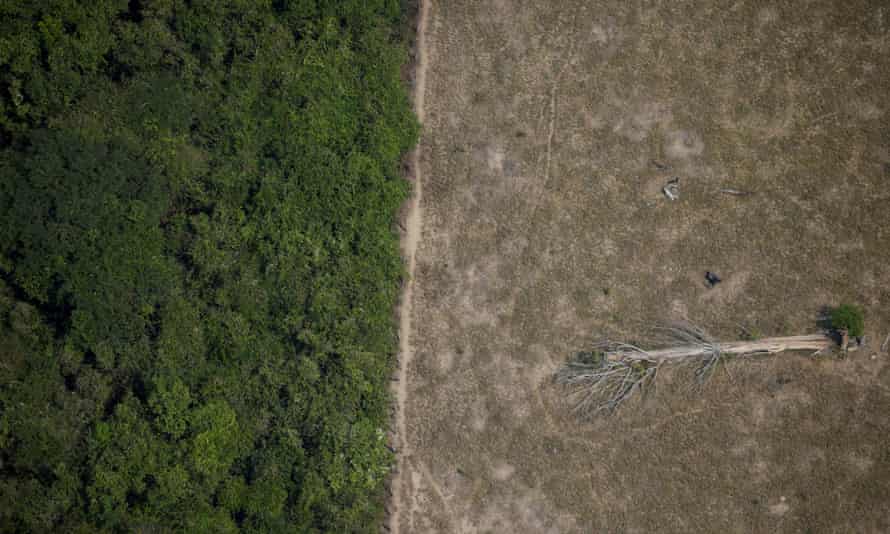
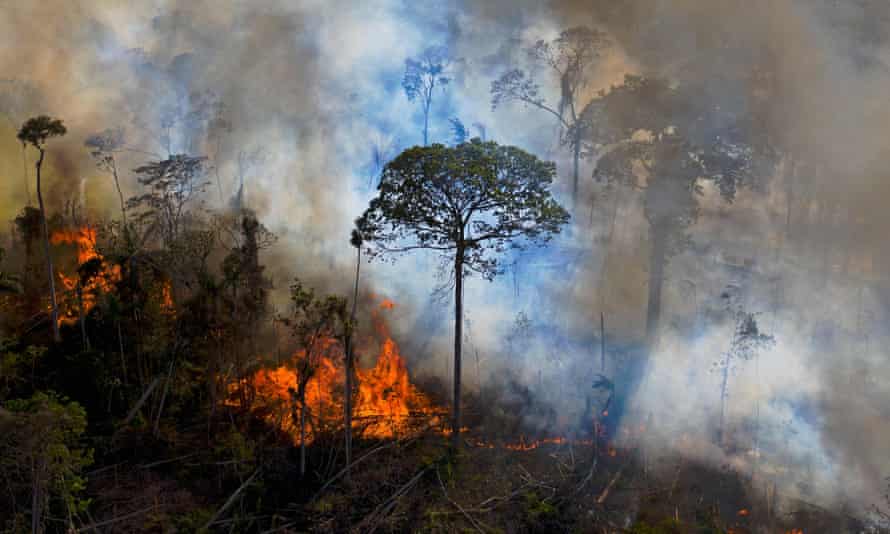
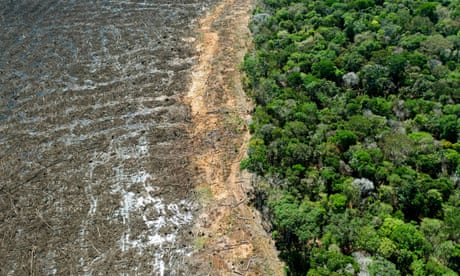
The study also showed that deforestation – through fires and clear-cutting – increased nearly four-fold in 2019 compared with either of the two previous years, from about 1m hectares (2.5m acres) to 3.9m hectares (9.6m acres).
“Brazil saw a sharp decline in the application of environmental protection policies after the change of government in 2019,” the INRA said in a statement.
Brazilian president Jair Bolsonaro was sworn into office on 1 January 2019.
Terrestrial ecosystems have been a crucial ally as the world struggles to curb CO2 emissions, which topped 40bn tonnes in 2019.
Over the past half-century, plants and soil have consistently absorbed about 30% of those emissions, even as those emissions increased by 50% over that period. Oceans have also helped, soaking up more than 20%.
The Amazon basin contains about half of the world’s tropical rainforests, which are more effective at soaking up and storing carbon than other types of vegetation.
If the region becomes a net source rather than a “sink” of CO2, tackling the climate crisis will be that much harder.
Using new methods of analysing satellite data developed at the University of Oklahoma, the international team of researchers showed for the first time that degraded forests were a more significant source of planet-warming CO2 emissions that outright deforestation.
Over the same 10-year period, degradation – caused by fragmentation, selective cutting, or fires that damage but do not destroy trees – caused three times more emissions than outright destruction of forests.
The data examined in the study only covers Brazil, which holds about 60% of the Amazonian rainforest.
Taking the rest of region into account, “the Amazon basin as a whole is probably (carbon) neutral”, said Wigneron.
“But in the other countries with Amazon rainforest, deforestation is on the rise too, and drought has become more intense.”
Climate change looms as a serious threat, and could – above a certain threshold of global heating – see the continent’s rainforest tip into a much drier savannah state, recent studies have shown.
This would have devastating consequences not only to the region, which is host to a significant percentage of the world’s wildlife, but globally as well.
 Abycats' Thoughts
Do you think that this disaster was caused by human?
LikeLike
Yes. The destruction of the forest is largely due to human’s who have burned it to use as farmland.
LikeLike
The greater the number of human population, the more they need space for shelter, food and resources. Who knows when the carrying capacity of our earth still can sustain human life.
LikeLiked by 1 person
But there are more and less productive ways for humans to survive. The Amazon Rain Forest has been a uniquely helpful part of the globe as the lungs of the world — and we haven’t even begun to discover all of the ways in which its flora and fauna could be useful. It’s a sorrow to see it destroyed for so little.
LikeLike
The human tendency is neglect to something that has no immediate impact, as I have posted at:
https://love-ely.blogspot.com/2010/03/global-warming-and-smoking.html
But human have the intelligence to create environmentally friendly technologies, such as electric car, solar energy, agricultural techniques which is more productive with less land.
However, for poor / under developing countries, they still need to struggle to get this technology in terms of capability and cost.
LikeLike