http://www.vulture.com/article/jorie-graham-poetry-profile.html? [click thru to listen to several of the poems]
Late Work
How the poet Jorie Graham — living with cancer, reeling from her mother’s death — wrote the best book of her long career.
By Kerry Howley
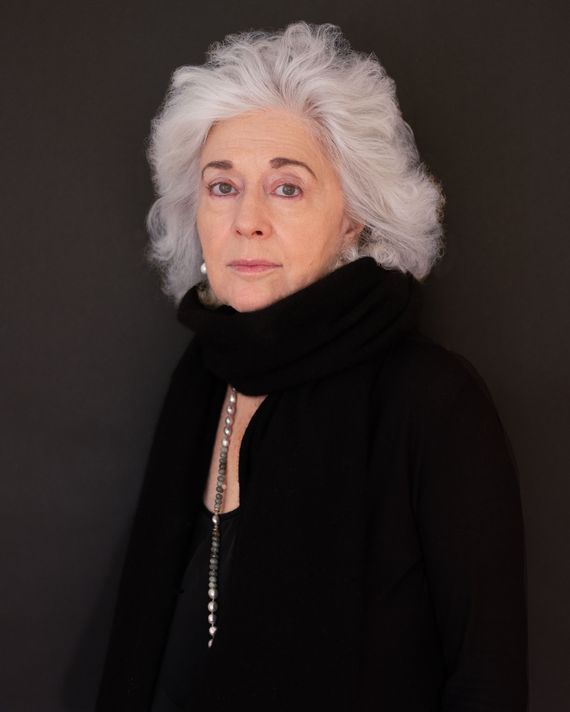
Photo: Jeannette Montgomery Barron
This article was featured in One Great Story, New York’s reading recommendation newsletter. Sign up here to get it nightly.
To speak into silence is something very dramatic” is something Jorie Graham is given to say, and it is a statement that seems true when she in particular says it. Silence “is the sound of the earth.” Silence “does not need you to interrupt it.” Interrupting the silence is something one must justify, ideally by becoming the person who can write the book worthy of breaking it. In February 2022, it had been four months since her diagnosis, 15 since her husband was helicoptered to a hospital, two years since she watched her mother die. She lived on an island formed 20,000 years ago by a moving wall of ice.
The day is long, she once wrote. It flirts with nothingness. It always does. The clock in her kitchen read, as it has for many years now, 9:42. She pulled long strands of brown hair off her furniture, a nuisance. She took out a pair of kitchen scissors and cut the rest off her head. The days were diminishing, but they always are. She wrote new poems that felt like the old poems and rejected them. She read others to whom the words had somehow come: Carlo Rovelli, Barry Lopez, Byung-Chul Han, Emily Dickinson; “Always Dickinson.” When she was too sick to read, she watched documentaries. The silence was heavy and unyielding. Maybe it’s over, she thought. Maybe that’s all I was called to do. Every poet, according to Jorie Graham, brings a different quality to silence. “If you read Czeslaw Milosz, the silence he’s writing into has history in it,” she says, “and if you read Dickinson, the silence has God or his absence in it.” Jorie Graham claims she doesn’t know what silence she is breaking. But I’m telling you now, the silence has time in it.
A Jorie Graham poem is a deep burrow into a position from which one can gather nothing but the sense of being terribly alive. It is a nakedness from which story will not appear to save you. There are many writers with righteous self-assurance, and many comfortable with bewilderment, and they are only rarely the same people. It is Graham’s unearthly self-possession in the presence of mystery that renders her poetry so strange. Listen it’s trying / to make a void again. In which to hear itself. It’s too alone, she wrote in 2020’s Runaway, a book full of long fast lines, a work that manages to convey the feeling of time while existing as a person on the internet, overcome, targeted, whelmed by information that never reaches the status of knowledge.
I had hoped to escape. To form one lucid
unassailable
thought. About what? It did not matter
about what. It just needs to be, to be
shapely and true.
The strength of Graham’s influence can be felt across the thousands of students who have passed through her classroom, the prestige of a position at Harvard formerly occupied by Seamus Heaney and John Quincy Adams, a solid set of major awards (Guggenheim, MacArthur, Pulitzer) bestowed upon her. Each of her 15 books feels radical within the context of American poetry, none more so than her latest five, which are startlingly accessible and immediate, written as if for a person impatient to understand the nature of matter. There is no one in the world of poetry who hasn’t read her, formed an opinion of her, heard or told or recast a story about her.
The stories have their own trajectory, broken free of the life that inspired them. By winter of last year, Jorie Graham’s public identity had coalesced into a narrative that did not quite feel right to its protagonist; the details so readily lend themselves to mythology the texture of truth shakes free. An uncommonly beautiful American raised in Rome by an artist and a foreign correspondent, educated at the Sorbonne and Writers’ Workshop, professor at Iowa and Harvard. A six-year marriage to Bill Graham, the heir to the Washington Post, during Watergate, at the dinner table while Kay Graham decided whether or not to publish. A second marriage spanning 16 years, to poet James Galvin, this one mythologized in real time as the Contessa and the Cowboy. All of it obscured what it was like to be Jorie Graham, perceiving the surface of a spinning planet. “If you open yourself up and look at a Goya, it could kill you,” she once said. That was what it was like.
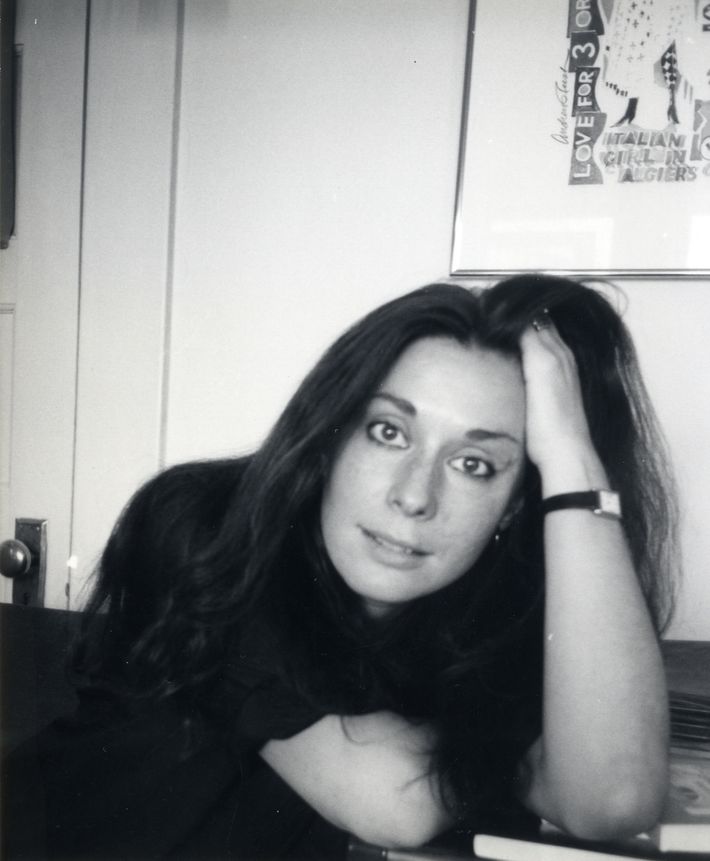
Jorie Graham at the University of Arizona Poetry Center in 1982. Photo: Lois Shelton/©1982 Arizona Board of Regents. Courtesy of The UArizona Poetry Center.
When Jorie Pepper was a toddler she lived in a small apartment in Rome that smelled of turpentine and lemons. This was 1953, 1954, her father an American journalist, her mother a Brooklyn-born painter with a storybook name, Beverly Pepper. Money was scarce and the nation lately devastated by not one but two wars. Beverly, painting in the living room, left to fetch something. Jorie was 3 years old looking at the realist scene her mother had rendered — mountains and people and animals. Jorie, alone for a moment, placed her finger in a swirl of brilliant oil. She traced wet loops on the canvas as her mother walked back in. Jorie had never seen her mother lose her temper before; she would never see her lose it again. Beverly picked up her daughter and threw her across the room. From his office Jorie’s father came running. This story is told without the slightest hint of self-pity; it is not a record of trauma, not a failure of affection. That was not what had been communicated at all. “I understood something there,” she says now. The work of art, she saw, was vivid and urgent in her mother’s mind, real, “more real than me.”
“Can you hear it?” Beverly once said to her young daughter, standing in a field. “What?” asked Jorie, alarmed. “The pull of the earth.” Beverly Pepper claimed to be able to hear it at its center, its molten iron core. Jorie thought she was mad, though it was not a madness one could dismiss. Standing next to her was like standing next to a divinity, a force. Beverly Pepper loved ice cream, vodka, and baseball. She wore clothes she’d made herself from material she bought at the Roman flea market where you could buy back your bike after it was stolen. She was having some kind of crisis and took 10-year-old Jorie on a six-month tour of the world. In Angkor Wat, among the monkeys and the roots and the buildings the roots had thrust up from the earth, Beverly Pepper decided she was a sculptor, not a painter. In Japan, she bought Jorie a kimono and forced her to go to Japanese school with it, though Jorie did not know Japanese, and the family they were staying with sent their own child to school in western dress. In India, she stood on the banks of the Ganges and declared that she and her child would wade into water scattered with the ashes of the dead. I know I didn’t even touch that place, Jorie wrote later, in a poem in which she describes screaming in the hotel afterward, sedated with Demerol. She / tried to hold me to her, I’m sure, / making it worse, / since her body (in particular) was / no longer relevant.
Beverly Pepper the sculptor called her daughter in from playing to hold some metal as she welded. The sparks were cold. She stopped wearing fantastical clothes and pared back to jeans and boots and work gloves; “to get out of the way of the work.” She got commissions and added and added, spent the commission to improve the materials and make the work bigger.
[Use the URL at the top to read the rest of this profile.]
 Abycats' Thoughts