LATER: Apparently Licht chose to have an audience full of people who were total Trump fans. How could he possibly label an hour of THIS as news? http://www.vanityfair.com/news/2023/06/donald-trump-chris-licht-cnn-town-hall He made CNN a laughing stock.
http://www.theatlantic.com/politics/archive/2023/06/cnn-ratings-chris-licht-trump/674255/? [click thru for the remainder of the article[
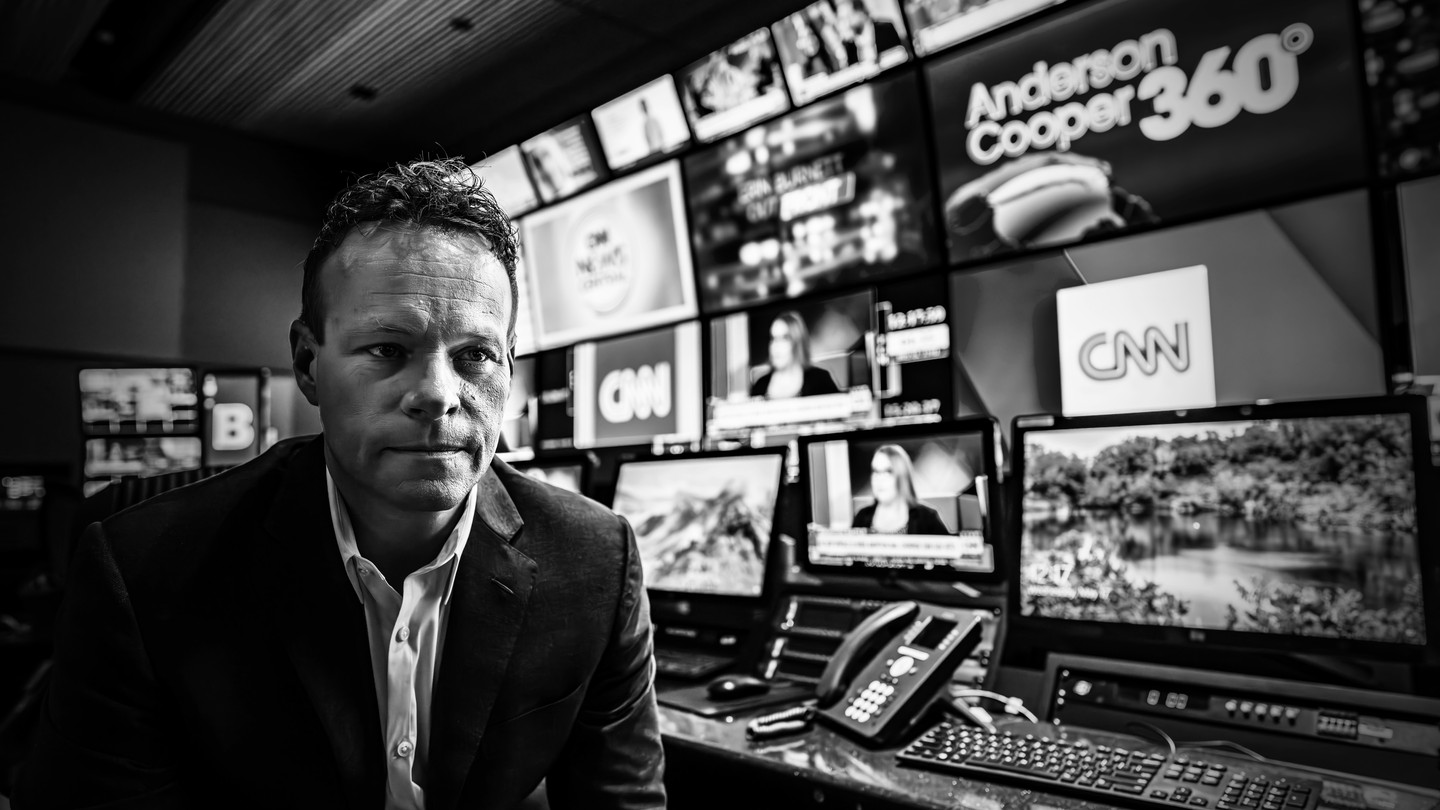
INSIDE THE MELTDOWN AT CNN
CEO Chris Licht felt he was on a mission to restore the network’s reputation for serious journalism. How did it all go wrong?
By Tim Alberta
Photographs by Mark Peterson
JUNE 2, 2023, 9 AM ET
This article was featured in One Story to Read Today, a newsletter in which our editors recommend a single must-read from The Atlantic, Monday through Friday. Sign up for it here.
“How are we gonna cover Trump? That’s not something I stay up at night thinking about,” Chris Licht told me. “It’s very simple.”
It was the fall of 2022. This was the first of many on-the-record interviews that Licht had agreed to give me, and I wanted to know how CNN’s new leader planned to deal with another Donald Trump candidacy. Until recently Licht had been producing a successful late-night comedy show. Now, just a few months into his job running one of the world’s preeminent news organizations, he claimed to have a “simple” answer to the question that might very well come to define his legacy.
“The media has absolutely, I believe, learned its lesson,” Licht said.
Sensing my surprise, he grinned.
“I really do,” Licht said. “I think they know that he’s playing them—at least, the people in my organization. We’ve had discussions about this. We know that we’re getting played, so we’re gonna resist it.”
Seven months later, in Manchester, New Hampshire, I came across Licht wearing the expression of a man who had just survived a car wreck. Normally brash and self-assured, Licht was pale, his shoulders slumped. He scanned the room with anxious eyes. Spotting me, he summoned a breezy chord. “Well,” Licht said, “that wasn’t boring!”
We were standing in the lobby of the Dana Center, on the campus of Saint Anselm College. Licht, the 51-year-old chair and CEO of CNN Worldwide, had spent the past hour and a half inside a trailer behind the building, a control room on wheels from which he’d orchestrated a CNN town hall with Trump. Licht had known the risks inherent to this occasion: Trump had spent the past six years insulting and threatening CNN, singling out the network and its journalists as “fake news” and “the enemy of the people,” rhetoric that had led to death threats, blacklists, and ultimately a severing of diplomatic ties between Trump and CNN leadership.
But that had been under the old regime. When he took the helm of CNN, in May 2022, Licht had promised a reset with Republican voters—and with their leader. He had swaggered into the job, telling his employees that the network had lost its way under former President Jeff Zucker, that their hostile approach to Trump had alienated a broader viewership that craved sober, fact-driven coverage. These assertions thrust Licht into a two-front war: fighting to win back Republicans who had written off the network while also fighting to win over his own journalists, many of whom believed that their new boss was scapegoating them to appease his new boss, David Zaslav, who’d hired Licht with a decree to move CNN toward the ideological center.
One year into the job, Licht was losing both battles. Ratings, in decline since Trump left office, had dropped to new lows. Employee morale was even worse. A feeling of dread saturated the company. Licht had accepted the position with ambitions to rehabilitate the entire news industry, telling his peers that Trump had broken the mainstream media and that his goal was to do nothing less than “save journalism.” But Licht had lost the confidence of his own newsroom. Because of this, he had come to view the prime-time event with Trump as the moment that would vindicate his pursuit of Republican viewers while proving to his employees that he possessed a revolutionary vision for their network and the broader news media.
Trump had other ideas.
For 70 minutes in Manchester, the former president overpowered CNN’s moderator, Kaitlan Collins, with a continuous blast of distortion, hyperbole, and lies. The audience of Trump devotees delighted in his aggression toward Collins, cheering him on so loudly and so purposefully that what began as a journalistic forum devolved into a WWE match before the first voter asked a question. Vince McMahon himself could not have written a juicier script: Trump was the heroic brawler—loathed by the establishment, loved by the masses—trying to reclaim a title wrongly taken from him, while Collins, standing in for the villainous elites who dared to question the protagonist’s virtue, was cast as the heel. “She’s not very nice,” Trump told the studio audience, pointing toward Collins while she stood just offstage during the first commercial break.
RECOMMENDED READING
- Economics: The Discipline That Refuses to ChangeANTARA HALDAR
- ‘Success Addicts’ Choose Being Special Over Being HappyARTHUR C. BROOKS
- There’s No Substitute for PrintANDREW FERGUSON
Trump could be excused for thinking this was exactly what Licht wanted. The famously transactional ex-president had wondered aloud to his top aides, during their negotiations with CNN executives, what the network stood to gain from this production; when CNN made the decision to stock the auditorium with Republicans, the only thing Trump could figure was that Licht wanted a prime-time spectacle to resuscitate the network’s moribund ratings. The two men spoke only briefly backstage. “Have fun,” Licht told him. Trump obliged. He demeaned the woman, E. Jean Carroll, whom a jury had one day earlier found him liable for sexually abusing. He repeated disproved fictions about election fraud and suggested that he would separate families at the southern border again if given the chance. He insulted Collins, calling her “a nasty person” as the crowd hissed in agreement. At one point, when she and Trump assumed their marks onstage after another commercial break, Collins politely reminded him not to step past the giant red CNN logo in front of them. Trump responded by gesturing as though he might stomp on it. The crowd roared in approval.
Licht had not wanted this. Sure, he was chasing ratings; in nearly 20 years as a showrunner, ratings had been his currency. But Licht had come to Manchester with bigger ambitions than lifting CNN out of the viewership basement for a single evening in May. He believed that Trump owed his initial political ascent in part to the media’s habit of marginalizing conservative views and Republican voters. That needed to change ahead of 2024. Licht wasn’t scared to bring a bunch of MAGA enthusiasts onto his set—he had remarked to his deputies, in the days before the town hall, about the “extra Trumpy” makeup of the crowd CNN was expecting—and he damn sure wasn’t scared of Trump. The way to deal with a bully like Trump, Licht told his journalists, was to confront him with facts.
Collins tried to do just that. She was, however, no match for the environment she’d been thrust into. Squaring off one-on-one against the country’s most accomplished trickster is difficult enough, but this was 300-on-one. The result was a campaign infomercial: Trump the populist champion, slaying his old nemesis and asserting to televised fanfare his claim to the presidency.
“Does CNN count that as an in-kind campaign donation?” the longtime broadcaster Dan Rather tweeted.
Rather’s comment was gentle compared with the torrent of criticism aimed at CNN. “Ready to call it: This was a terrible idea,” the conservative writer Ramesh Ponnuru tweeted, just nine minutes into the event. “CNN should be ashamed of themselves,” tweeted Democratic Representative Alexandria Ocasio-Cortez. “This is an absolute joke,” tweeted former Republican Representative Adam Kinzinger. “Chris Licht is rapidly becoming the Elon Musk of CNN,” tweeted The Bulwark’sCharlie Sykes.
When Licht found me in the lobby, commenting on how not boring the night had been, it wasn’t clear how much of the blowback he’d already seen. What was clear was that Licht knew this was bad—very, very bad. Republicans were angry at CNN. Democrats were angry at CNN. Journalists were angry at CNN. The only one who wasn’t angry, it seemed, was Trump, most likely because he’d succeeded in disgracing the network on its own airwaves.
I felt for Licht. Having spent long stretches of the past year in conversation with him as he attempted to build “the new CNN,” I often found myself agreeing with his principles of journalism. Some media figures had trashed Licht for hosting the town hall in the first place, arguing that nothing good could come from “platforming” a man who’d tried to sabotage the peaceful transition of power. Licht disagreed—and so did I. Trump was the runaway favorite for the GOP nomination and a decent bet to occupy the White House in two years. The media had every obligation to scrutinize him, interview him, and, yes, platform him.
As I’d settled into my seat in the Saint Anselm auditorium, however, I had been startled by my surroundings. This was no ordinary collection of Republicans and GOP-leaning independents, as CNN had claimed it would be. Most of them were diehards, fanboys, political zealots who were likelier to show up at a rally with a MAGA flag than come to a coffee shop with a policy question. These folks hadn’t turned out to participate in some good-faith civic ritual. They were there to celebrate Trump’s continued assault on the media.
Licht’s theory of CNN—what had gone wrong, how to fix it, and why doing so could lift the entire industry—made a lot of sense. The execution of that theory? Another story. Every move he made, big programming decisions and small tactical maneuvers alike, seemed to backfire. By most metrics, the network under Licht’s leadership had reached its historic nadir. In my conversations with nearly 100 employees at CNN, it was clear that Licht needed a win—a big win—to keep the place from falling apart. The Trump town hall was supposed to be that win. It had to be that win. And yet, once again, the execution had failed.
Pulling me into a darkened corridor just outside the auditorium, Licht tried to compose himself. He and I had spent many hours discussing what he described as “the mission” of CNN. I asked Licht whether the town hall had advanced that mission. He bit his lip.
“Too early to say,” Licht replied.
[huge chunk deleted — read full article by clicking on URL above]
Licht knew “immediately” that he had to accept. Yet he was not oblivious to the challenges that awaited. His wife, Jenny Blanco, had worked for CNN as a producer. He knew some of the premier on-air talent. Both Colbert and Scarborough warned him not to take the job, and Licht understood their reservations. He had watched, over the previous five years, as the network became more polarizing. When I asked Licht what he’d thought about CNN—as a viewer, and as a seasoned journalist himself—while working on Colbert’s show, he hesitated, searching for the words.
“I thought, I’m having a tough time discerning between ‘How much are we getting played as an audience by Trump?’ and how much of it’s actually …” He trailed off.
Licht said Trump had done “really bad shit” as president that reporters sometimes missed because they were obsessing over more sensational stories. Trump had goaded the media with “outrage porn,” provoking journalists to respond with such indignation, so often, that audiences began to tune out. “When everything is an 11” on a scale of 10, Licht said, “it means that when there’s something really awful happening, we’re kind of numb to it. That was a strategy. And I felt like the media was falling for that strategy.”
Licht recalled how, early in the Trump administration, a particular reporter hadn’t been allowed into a press gaggle because of a feud with the White House. During a subsequent meeting with his fellow board members at Syracuse’s Newhouse school of journalism, one of them suggested taking out a full-page ad in The New York Times denouncing this affront to the First Amendment. “And I’m like, ‘Guys, keep your powder dry. This is nothing. It’s gonna get much worse,’” Licht said.
“I felt that there was such a mission—” He stopped himself.
“The mission was to go after this guy—” He stopped again.
“Right or wrong. I’m not saying he’s a good guy. He’s definitely not,” Licht said of Trump. “But, like, that was the mission … Sometimes something should be an 11; sometimes it should be a two; sometimes it should be a zero. Everything can’t be an 11 because it happens to come from someone you have a visceral hatred for.”
I told Licht that while I agreed with his observation—that Trump had baited reporters into putting on a jersey and entering the game, acting as opposing players instead of serving as commentators or even referees—there was an alternative view. Trump had forced us, by trying to annihilate the country’s institutions of self-government, to play a more active role than many journalists were comfortable with. This wasn’t a matter of advocating for capital-D Democratic policies; it was a matter of advocating for small-d democratic principles. The conflating of the two had proved highly problematic, however, and the puzzle of how to properly cover Trump continued to torment much of the media.
Licht didn’t understand all the fuss. “If something’s a lie, you call it a lie. You know what you’re dealing with now,” he said. “I think he changed the rules of the game, and the media was a little caught off guard and put a jersey on and got into the game as a way of dealing with it. And at least [at] my organization, I think we understand that jersey cannot go back on. Because guess what? It didn’t work. Being in the game with the jersey on didn’t change anyone’s mind.”
l, was the model: tough, respectful, inquisitive reporting that challenged every conceivable view and facilitated open dialogue.
[another big chunk omitted]
The next time I saw Licht was two months later in Manchester.
The CNN newsroom had been stunned by the news of the May 10 town hall. Internally, questions about whether the network would platform Trump in the run-up to the 2024 campaign had felt very much unanswered. Almost no one—not even CNN’s leading talent, people who had long-standing relationships with Trump and his top aides—knew about the negotiations to host a town hall. When it was announced, Licht made a forceful argument to his employees about the merits of a live event. The campaign was under way; Trump was the front-runner and needed to be covered. Rather than giving him unfiltered access to their viewers via rallies, Licht said, CNN could control the presentation of Trump with its production decisions, its questioning, its live fact-checking. To varying degrees, his skeptics told me, they bought in.
But anxieties grew as the town hall approached. Employees found it strange that none of the CNN anchors who’d interviewed Trump—Anderson Cooper, Jake Tapper, Erin Burnett, Wolf Blitzer, Chris Wallace—was invited to play a role in preparing for the event, whether by shaping questions, suggesting best practices, or simply advising Collins. Trump speculated on social media about the town hall turning into a disaster, prompting fears among executives that he might stage a stunt by walking off the set, which in turn prompted fears among staffers about what, exactly, the network would do to keep Trump on the set. In the final days before the event, concerns about the audience makeup spiked as Licht’s description of the crowd—“extra Trumpy”—wound its way through Slack channels and text-message threads.
All of these concerns, it turned out, were warranted. Preparation was clearly an issue. Collins did an admirable job but was steamrolled by Trump in key moments; her questions, which came almost entirely from the candidate’s ideological left, served to effectively rally the room around him. Not that the room needed rallying: The crowd was overwhelmingly pro-Trump, and because CNN wanted an organic environment, it placed few restrictions on engagement. The ensuing rounds of whole-audience applause—I counted at least nine—disrupted Collins’s rhythm as an interviewer. So did the ill-timed bouts of laughter, such as when Trump mocked E. Jean Carroll, and the jeering that accompanied Collins’s mention of the Access Hollywood tape. By the end of the event, it was essentially indistinguishable from a MAGA rally. People throughout the room shouted, “I love you!” during commercial breaks and chanted “Four more years!” when the program ended.
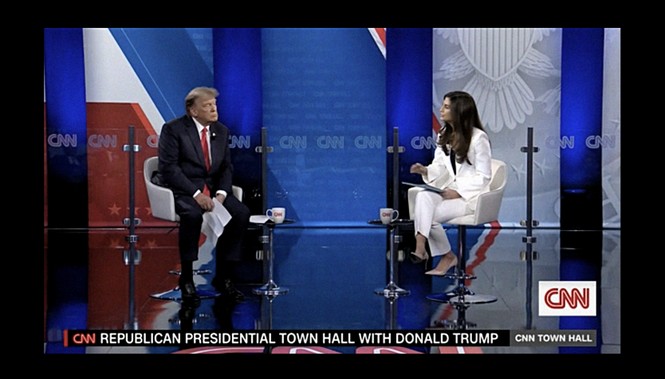
As attendees emptied into the lobby, it felt as though fans were celebrating the home team’s victory over a hated rival. People I talked with lauded Trump and loathed CNN in equal proportion. Christopher Ager, the state party chair, captured their sentiments best: “We knew that CNN had new leadership. It seemed like they had a different tone, like they were going to be fair to Trump, fair to Republicans. But I didn’t see that tonight,” he said. “This was the old CNN.”
Two hundred fifty miles away, on the set in New York, CNN staffers were perplexed. The initial plan had called for Scott Jennings, a Republican who is less than enamored of Trump, to join his familiar grouping of pundits on the postgame show. CNN had flown Jennings to New York for the occasion. However, hours before the town hall, a switch was announced internally: Byron Donalds would be substituted for Jennings (who wound up coming on the air with another panel much later that night). Donalds, a Republican congressman from Florida, is an election denier—someone who, to use Licht’s language, says it’s not raining in the middle of a downpour. It was enough of a problem for some CNN staffers that Trump, the original election denier, was flouting Licht’s oft-repeated standard. But why was Donalds on CNN’s postgame panel?
This wasn’t the only peculiar personnel move. Sarah Matthews, a Trump-administration official who’d turned critical of her former boss, had been slated to appear on the pregame show. But she was abruptly nixed in favor of Hogan Gidley, a former White House staffer who remained devoted to Trump.
Live television is a volatile thing. People and sets and scripts are always being changed for all kinds of reasons. Still, CNN employees had reason to be suspicious. They wondered if some sort of deal had been cut with Trump’s team, promising the placement of approved panelists in exchange for his participation in the town hall. At the least, even absent some official agreement, it seemed obvious that CNN leaders had been contorting the coverage to keep Trump happy—perhaps to prevent him from walking offstage. At one point during the pregame show, when the words sexual abuse appeared on the CNN chyron, one of Licht’s lieutenants phoned the control room. His instructions stunned everyone who overheard them: The chyron needed to come down immediately.
When the town hall ended, two postgame panels kicked off concurrently, giving network executives the flexibility to switch between reporting and analysis. One panel, anchored by Tapper, was a roundtable of journalists picking apart Trump’s lies. The other, led by Cooper, featured partisan pundits—including Donalds—debating one another. According to the mission that Licht had articulated for me, Tapper’s panel should have starred that night. But it didn’t. Licht made the call to elevate Cooper’s panel (a fact first reported by Puck). This decision may or may not have come from the very top: In the days after the town hall, Zaslav told multiple people that Tapper’s Trump-bashing panel reminded him of Zucker’s CNN. Yet even that MAGA-friendly version wasn’t good enough for Donalds. After criticizing the network on-air, the congressman stepped off the set and then, in full view of the crew as well as his fellow panelists, grabbed his phone and started blasting CNN on Twitter.
Licht was still coming to terms with the ferocity of the backlash later that night when CNN’s popular Reliable Sources newsletter landed in his inbox. He read the opening line in disbelief: “It’s hard to see how America was served by the spectacle of lies that aired on CNN Wednesday evening,” Licht’s own media reporter, Oliver Darcy, wrote.
Licht could handle being ridiculed by his media rivals. But being publicly scolded by someone on his own payroll—on the biggest night of his career—felt like a new level of betrayal. Licht, who just hours earlier had expressed ambivalence to me about how the event played, went into war mode.
The next morning, he began the 9 o’clock editorial call with a telling choice of words: “I absolutely, unequivocally believe America was served very well by what we did last night.”
Lots of cnn employees on that morning call disagreed with Licht. They thought his execution of the event had been dreadful; they believed his tactical decisions had essentially ceded control of the town hall to Trump, put Collins in an impossible position, and embarrassed everyone involved with the production. These opinions were widely held—and almost entirely irrelevant. Everyone at CNN had long ago come to realize that Licht was playing for an audience of one. It didn’t matter what they thought, or what other journalists thought, or even what viewers thought. What mattered was what David Zaslav thought.
I was looking forward to finding out. For months, Zaslav’s head of communications, Nathaniel Brown, had been shielding his boss from participating in this story. He first told me that Zaslav would speak to me only without attribution, and any quotes I wanted to use would be subject to their approval. When I refused—telling Brown that quote approval was out of the question, and that I would meet Zaslav only if he allowed on-the-record questioning—he reluctantly agreed to my terms, but then tried running out the clock, repeatedly making Zaslav unavailable for an interview. Finally, after false starts and a painstaking back-and-forth, the interview was set. I would meet Zaslav on Wednesday, May 17—one week after the Trump town hall—at his office in New York.
On Tuesday evening, less than 24 hours before that meeting, Brown called me. “We’re going to keep this on background only, nothing for attribution,” he said. This was a brazen renege on our agreement, and Brown knew it. He claimed that it was out of his hands. But, Brown tried reassuring me, “with everything going on,” Zaslav thought “he could be most helpful to you by explaining some things on background.”
I wasn’t entirely surprised. Over the previous year, people who knew Zaslav—and who had observed his relationship with Licht—had depicted him as a control freak, a micromanager, a relentless operator who helicoptered over his embattled CNN leader. Zaslav’s constant meddling in editorial decisions struck network veterans as odd and inappropriate; even stranger was his apparent marionetting of Licht. In this sense, some of Licht’s longtime friends and co-workers told me, they pitied him. He was the one getting mauled while the man behind the curtain suffered nary a scratch. I declined Brown’s offer. I told him this was Zaslav’s last chance to make the case for Licht’s leadership—and his own. If he wanted to explain things, he could do so on the record, as we had agreed. Zaslav refused.
The day after that canceled meeting, I sat down with Licht for the final time, at a restaurant overlooking Hudson Yards. I told him about the perception that Zaslav doesn’t let him do his job. Licht looked temporarily frozen.
“I don’t feel that at all,” he said. “I feel like I have someone who’s a great partner, who has my back and knows a lot about this business.”
“Do you feel like you’ve been able to be yourself on this job?” I asked.
“Where does that question come from? What are you getting at? Like, myself?” he asked, looking incredulous. Licht chewed on his lip for a moment. “I think it’s very different—a CEO job is just very different. Every word you say is parsed. Every way you look at someone is parsed. It’s just different. So I try to be as much of my authentic self as possible within the natural confines of the job.”
I explained where the question was coming from. People at CNN think he’s “performative,” I told Licht, as though he’s projecting this persona of a bulletproof badass because that’s what Zaslav wants to see. His staffers also think he’s become so bent on selling this image that it’s crushed his ability to build real, meaningful relationships with key people there who want him to succeed.
CNN employees had asked me, again and again, to probe for some humility in their leader. If nothing else, they wanted some morsel of self-awareness. They hoped to see that he knew how poorly his tenure was playing out, and why. But Licht would not bite. At one point, I asked him whether he regretted moving his office to the 22nd floor. Licht sat in silence for more than a minute—cracking his neck, glancing around, appearing at one point as though he might not answer the question at all.
Finally, he exhaled heavily. “I didn’t mean for it to become a thing. And it became a thing. So, sure.”
“Only because it became a thing?” I asked.
“Sure,” he replied.
Licht wasn’t going to give me—or, more accurately, his employees—the satisfaction of admitting this error. He certainly wasn’t going to acknowledge everything else that had gone wrong. Even with CNN falling behind Newsmax in the ratings two nights after the town hall, Licht was unperturbed. Even with his employees in open revolt—a week after Darcy’s newsletter, Christiane Amanpour, perhaps the most accomplished journalist in CNN’s history, chided Licht in a speech at Columbia’s journalism school—he was staying the course.
I asked Licht whether there was anything he regretted about the event. The “extra Trumpy” makeup of the crowd? (No, Licht said, because it was representative of the Republican base.) Devoting the first question to his election lies? (No, Licht said, because nothing else, not even the E. Jean Carroll verdict, was as newsworthy as Trump’s assault on the ballot box.) Allowing the audience to cheer at will? (No, Licht said, because instructing them to hold their applause, as debate moderators regularly do, would have altered the reality of the event.) The lone point he ceded was that the crowd should have been introduced to viewers at home—with a show of hands, perhaps, to demonstrate how many had voted for Trump previously, or were planning to support him in 2024.
He gave no ground on anything else—not even the presence of Representative Donalds on the postgame show. Licht told me it probably didn’t make sense to seat a congressman on the pundits’ panel, but said he otherwise had no regrets, even after I pointed out that Donalds was an election denier who used his place on that panel to question the legitimacy of Joe Biden’s victory in 2020.
Had CNN struck a deal with Trump’s team, I asked, that required seating guests like Donalds and Gidley?
“Absolutely not,” Licht replied. “I can unequivocally say there was no agreement, no deal. Nothing.”
I shared with him a more popular theory of what had gone down. Lots of CNN employees believed there’d been no formal agreement, but rather an understanding: If Trump showed good faith in coming on CNN, the network needed to show good faith in booking some unusually pro-Trump voices for the pregame and postgame shows. I noted to Licht that many of his people believed this would have been agreed to without his knowledge, because he was focused on the bigger picture of producing the town hall. Was it possible, I asked, that his lieutenants might have reached that understanding with Trump’s team?
“Nnnno,” he said, dragging out the word, buying himself some time. “But I can—I mean, anything’s possible. But I would imagine it’s more along the lines of ‘If we are completely one-sided in our analysis, then that doesn’t serve the audience.’” He paused. “Like, [one] of the biggest misconceptions about that town hall is that I did it for ratings. It’s a rented audience”—that is, most viewers were not CNN regulars—“so I didn’t do it for ratings. I certainly didn’t do it for a profit, because it cost us money. And I certainly didn’t do it to build a relationship with Trump. So that would by definition preclude a lot of the conspiracy-theory dealmaking.”
Maybe it was a conspiracy theory. But over the past year, so many things that Licht’s employees had predicted—speculation he’d dismissed as wrong or shortsighted or unhinged—had proved true. Lemon was a disaster on the morning show. (Licht finally fired him in April.) Collins wasn’t better co-anchoring in New York than starring at the White House. (Licht gave her the 9 o’clock hour beginning this summer.) Licht had been fixated on the negative press about him. (He confronted Dylan Byers at a party in March, Licht admitted to me, and raged at the reporter about his coverage.) Zaslav did turn out to be comically intrusive. (In one incident, a day after the New York Post reported that Licht might soon be fired, Zaslav dropped into a CNN managerial meeting and declared to Licht’s underlings, “This is our rendezvous with destiny!”)
Licht had told me that he and Zaslav figured the “gut renovation” of CNN would require two years of work. But there was reason to believe that timeline was accelerating: Not long after our final interview, Warner Bros. Discovery announced the installation of CNN’s new chief operating officer, David Leavy, a Zaslav confidant whose hiring fueled talk of an imminent power struggle—and potentially, the beginning of the end for Licht.
In fairness, Jeff Zucker’s first few years at CNN were also brutal. There were layoffs and programming flops, and viewership was in decline. It wasn’t until Zucker found a rhythm with what CNN staff called his “swarm strategy,” which threw reporting resources at the hottest trending stories—disappearing planes, the “Poop Cruise,” and, ultimately, Trump’s candidacy—that CNN became a ratings behemoth. Licht’s poor start did not preclude a comeback. There was, he and his stalwarts told me, still time for him to be successful.
And yet, little in Licht’s first-year record indicated that success was on the way. His biggest achievement—luring Charles Barkley and Gayle King to co-host a show—was hardly going to revive CNN’s prime-time lineup. The program, “King Charles,” would air only once a week, leaving Licht still in search of the win he needed to juice CNN’s ratings—and perhaps save his job.
Near the end of our interview, I asked Licht to put himself in my shoes. If he were me, could he possibly write a positive profile of CNN’s leader?
He spent a long time in silence. “Absolutely,” Licht finally said.
If the answer was “absolutely,” I asked, why did he need so long to think about it?
“I wanted to be very sure,” he replied.
This was not the same man I’d met a year earlier. Once certain that he could tame Trump single-handedly, Licht still tried to act the part of an indomitable CEO. Yet he was now stalked by self-doubt. That much was understandable: Licht lived on an island, surrounded by people who disliked him, or doubted his vision for the company, or questioned his competency, or were outright rooting for his ruin. He had hoped the Trump town hall would make believers out of his critics. Instead, it turned his few remaining believers into critics. I had never witnessed a lower tide of confidence inside any company than in the week following the town hall at CNN. Some staffers held off-site meetings openly discussing the merits of quitting en masse. Many began reaching out to rival media organizations about job openings. More than a few called Jeff Zucker, their former boss, desperate for his counsel.
As we sipped our coffee, Licht tried to sound unflappable.
“I don’t need people to be loyal to Chris Licht. I need people to be loyal to CNN,” he said.
The only person whose loyalty he needed, I pointed out, was Zaslav.
Licht nodded slowly, saying nothing. Then, just as he started to speak, his wrist began buzzing and flashing. Licht glanced down at his smartwatch. Zaslav was calling him. He looked up at me. Seeing that I’d noticed, Licht allowed a laugh—a genuine laugh—then stood up from the table and answered his phone.
Tim Alberta is a staff writer at The Atlantic.
 Abycats' Thoughts