https://mashable.com/article/greenland-melted-sea-ice-dogs-sledding-photo/?
And
https://www.theguardian.com/world/2019/jun/18/photograph-melting-greenland-sea-ice-fjord-dogs-water?
This remarkable Greenland photo highlights extreme Arctic melting

Steffen M. Olsen@SteffenMalskaerCommunities in #Greenland rely on the sea ice for transport, hunting and fishing. Extreme events, here flooding of the ice by abrupt onset of surface melt call for an incresed predictive capacity in the Arctic @BG10Blueaction @polarprediction @dmidk
Rasmus Tonboe@RasmusTonboe@SteffenMalskaer got the difficult task of retrieving our oceanographic moorings and weather station on sea ice in North West Greenland this year. Rapid melt and sea ice with low permeability and few cracks leaves the melt water on top.
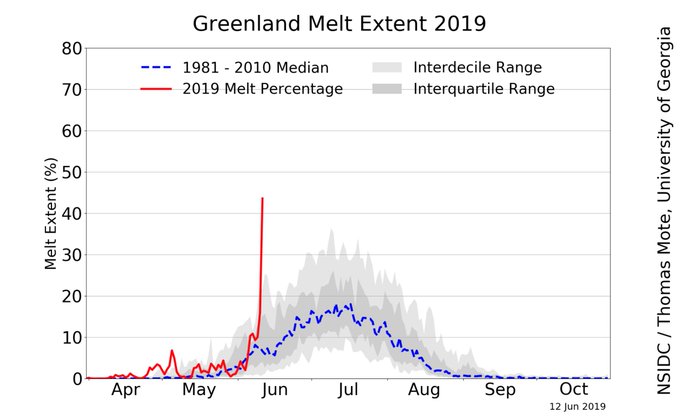
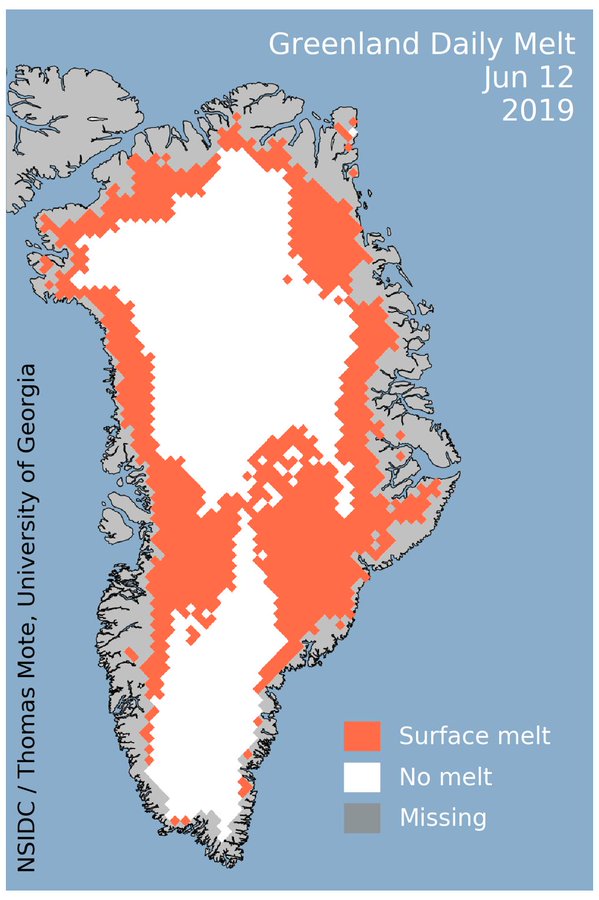
Temperatures have spiked in Greenland this week, resulting in melting not just of sea ice, but of ice across the surface of nearly half the giant island. Greenland has had big melting episodes before, but this one certainly falls into the category of extreme.
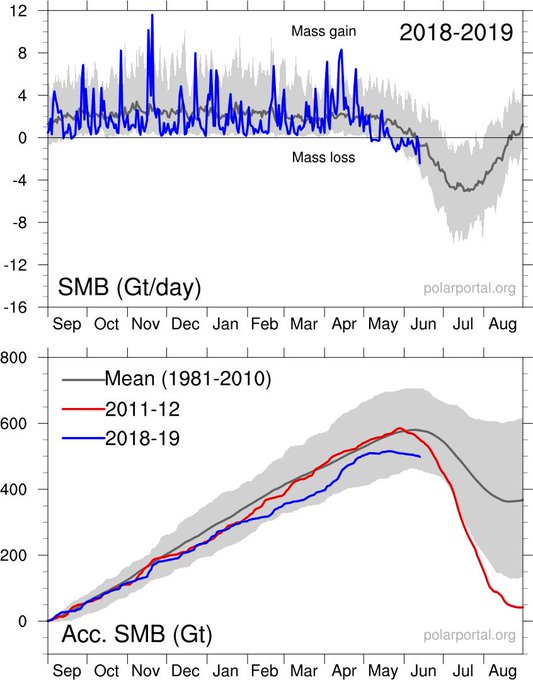
On Thursday alone, Greenland lost 2 billion metric tons of ice.
Greenland@greenlandicesmbYesterday (13th June), we calculate #Greenland #icesheet lost more than 2 Gt (2 km³) of ice,, melt was widespread but didn’t quite get to #SummitCamp which was just below 0°C
The high melt is unusual so early in the season but not unprecedentedhttp://polarportal.dk/en/greenland/surface-conditions/ …
389 people are talking about thisThough warming spells come and go each year, overall, the big picture across the melting landmass is clear: The Arctic is the fastest warming region of the world, an increase in background warming makes warm spells all the more extreme, and ice-clad Greenland is metaphorically in hot water.
“We see now that it’s melting faster than at any point in at least the last three and a half centuries, and likely the last seven or eight millennia,” Luke Trusel, a geologist at Rowan University told Mashable in December.
Eric Holthaus
✔@EricHolthaus
The Greenland ice sheet is currently going through a major melting this week, covering almost half its surface — unprecedented in its extent for this early in the year.
This has not happened before.
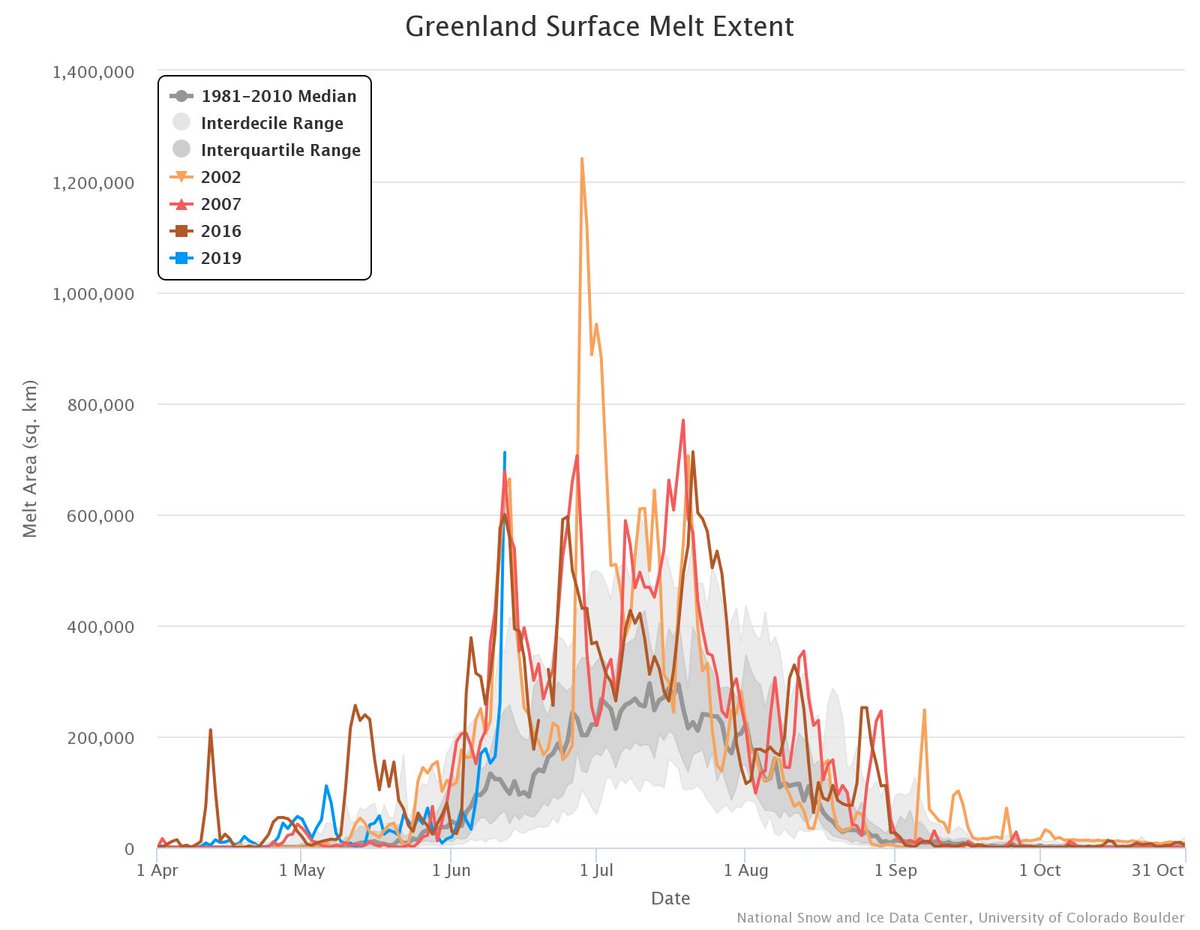
Robert Rohde@RARohdeA bit of perspective might be useful here.
The 2019 melt extent sets a new daily record for mid-June, but it is only a little bit higher than has occurred in a few other years. More of an incremental worsening than a dramatic one. pic.twitter.com/tAY3QgyvyT
The Arctic, of which Greenland is a major part, is now changing at rates some Arctic scientists struggle to explain.
“I’m losing the ability to communicate the magnitude [of change],” Jeremy Mathis, a longtime Arctic researcher and a current board director at the National Academies of Sciences told Mashable earlier this week. “I’m running out of adjectives to describe the scope of change we’re seeing.”





 Abycats' Thoughts